Pauri Garhwal
The Land of Pauri Garhwal is blessed with splendid view of snow-bound peaks of Himalayas, scenic valleys & surroundings, meandering rivers, dense forests and hospitable people with a rich culture. Diverse in topography, the district of Pauri Garhwal varies from the foothills of the ‘Bhabar’ areas of Kotdwara to the soul-lifting meadows of Dhudatoli, sprawling at an altitude of 3,000 meters.
Which remains snow-bound during the winter months.
Filled with places of tourist interest, most locations in Pauri Garhwal offer a breathtaking view of the snow laden Himalayan Splendour..
District Pauri Garhwal which is surrounded by the districts of Chamoli, Nanital, Bijnor, Haridwar, Dehradun, Rudraprayag and Tehri Garhwal,offers a panoramic view of the great Himalayas form it's towns and villages. The majestic Himalaya and it's mountain range can be seen from anywhere in the district.
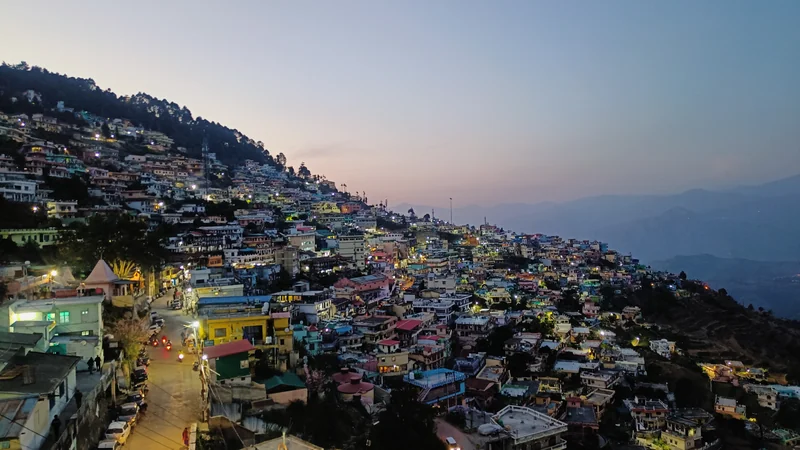
The Pauri City which is situated at an altitude of 1814 Mts. above the sea-level on the northern slopes of Kandoliya hills is the headquarters of the District Pauri Garhwal and the Garhwal Division. Headquarters of all Govt. departments are located in the city Pauri .
Pauri also provides a panoramic view of the snow covered Himalayan peaks of Nandadevi & Trisul,Gangotri Group,Thalaiya- sagar,Neelkanth, Bandar Poonch, Swarga-Rohini, Kedarnath, kharcha Kund, Satopanth, Chaukhamba, Ghoriparvat, Hathiparvat and Sumeru etc.
The Glorious Past... Through the ages, the evolution of human civilization in the Garhwal Himalayan has been parallel to the rest of Indian sub-continent. Katyuri was the first historical dynasty, which rule over unified Uttarakhand and left some important records in the form of inscriptions and temples. In later period after the downfall of Katyuri’s, it is believed that Garhwal region was fragmented in more than sixty-four principalities ruled by the Chieftain, one of the principal Chieftainship was Chandpurgarh, which was ruled by descendent of Kanakpal. In the mid of 15th century A.D. Chandpurgarh emerged as a powerful principality under the rule of Jagatpal (1455 to 1493 A.D.), who was a descendent of Kanakpal. In the fag end of 15th century Ajaypal enthroned the Chandpurgarh and succeeded in unifying and consolidating various principalities on the region with in a Kingdom and his Kingdom came to known as Garhwal. Subsequently, he had transferred his capital from Chandpur to Devalgarh before 1506 and later on to Srinagar during 1506 to 1519 A.D.
King Ajaypal and his successors ruled the Garhwal for nearly three hundred years even during this period they had faced a number of attacks from Kumaon, Mughal, Sikh, Rohilla. An important event in the history of Garhwal was the Gorkha invasion. It was marked by extreme brutality and the word ‘Gorkhyani’ has become synonymous with massacre and marauding armies.
After subjugating Doti and Kumaon, Gorkhas attacked Garhwal and reached as far as Langoorgarh despite stiff resistance put up by the Garhwali forces. But in the meantime, news came of a Chinese invasion and the Gorkhas were forced to lift the siege. However, in 1803, they again mounted an invasion.
After capturing Kumaon, they attach Garhwal in three columns. Five thousand Garhwali soldiers could not stand the fury of their attack and the King Pradyumna Shah escaped to Dehradun to organize his defense. But his forces were no match to the Gorkha might.
Garhwali soldiers suffered heavy casualties and the King himself was killed in the battle of Khudbuda. The Gorkhas became the masters of entire Garhwal in 1804 and ruled the territory for twelve years.
Gorkha ruled in the Garhwal area ended in 1815 when the British drove the Gorkhas to the West of Kali river, despite stiff resistance offered by them. After defeat of Gorkha army, the Britishers on 21 April 1815, decided to establish their rule over the eastern, half of the Garhwal region, which lies east of Alaknanda & Mandakini river, later on, known as ‘British Garhwal’ and Dun of Dehradun.
The remaining part of the Garhwal in the west was restored to King Sudershan Shah who established his capital at Tehri. Initially the administration was entrusted to the commissioner of the Kumaon and Garhwal with his headquarters at Nainital, but later Garhwal was separated and formed into a separate district in 1840 A.D. under an assistant commissioner with his headquarter at Pauri.
At the time of independence, Garhwal, Almora and Nainital districts were administered through commissioner of Kumaon division. In early 1960, Chamoli district was curved out of Garhwal district. In 1969 Garhwal division was formed with its headquarter at Pauri.
After curving out of seventy-two villages of Khirsu block of district Pauri Garwhal in 1998 for creation of new district of Rudraprayag, the district is reached in its present form.
Pauri Garhwal, a district of Uttarakhand state encompasses an area of 5230 sq. km and situated between 29° 45’ to 30°15’ Latitude and 78° 24’ to 79° 23’ E Longitude. This district is ringed by the districts of Chamoli, Rudraprayag & Tehri Garhwal in North, Bijnor & Udhamsingh Nagar in South, Almora & Nainital in East, Dehradun & Haridwar in West.
The District is administratively divided into nine tehsils, viz., Pauri, Lansdown, Kotdwar, Thalisain, Dhumakot, Srinagar, Satpuli, Dhumakot & Yamkeshwar and fifteen developmental blocks, viz., Kot, Kaljikhal, Pauri, Pabo, Thalisain, Bironkhal, Dwarikhal, Dugadda , Jaihrikhal, Ekeshwer, Rikhnikhal, Yamkeswar, Nainidanda, Pokhra & Khirsu.
Pauri is the headquarter of Pauri Garhwal district and is located at the height of 1650 m. and has a population of 24,743. This is fairly located on high altitude amongst the Deodar forest and on the northern slopes of the ridge, which provide one of the ice-clad mountain chains.
Besides Alaknanda, Nayyar River is the major river of the district and is one of the major tributies of Alaknanda which is called Nayyar after the confluence of eastern and Western Nayyar at Satpuli. Both the Nayyars originate from the Dudatoli range and drain their water to the south.
The high ranges in the Nayyar catchments areThailisain (Dudatoli - Chakisain ridge), Baijro (Pokhra - Demdeval ridge), Khirsu-Mandakhal (Pauri - Adwani - Kanskhet ridge), Bironkhal (Lansdowne - Gumkhal - Dwarikhal ridge) & Rathwadhab (Dugadda - Kandi ridge).
Climate.. The region has a sub-temperate to temperate climate, which remains pleasant throughout the year. The maximum temperature recorded in the month of june is 45°C at Kotdwar while in the higher reaches at Dudhatoli it only rises to 25°C. Temperature descends to a minimum of 1.3°C in January, and means monthly temperature for the region ranges from 25°C to 30°C.
The hilly terrain with its densely forested slopes receives adequate rainfall generally commencing from mid-June and extending till mid-September. Occasional rainfall is also recorded in winter. Average annual rainfall in the district is 218 cm., about 90 percent of which is generally concentrated over the monsoon.
Relative humidity varies between 54 and 63 percent. The higher reaches receive some snow in winter when temperature falls to freezing point.
Topograophy.. The topography of pauri Garhwal is by and large rugged and except for the narrow strip of Bhabar, the entire region is mountainous. The highest point of the area is 3116 mtrs at Dudatoli and the lowest point of the area is 295 mtrs near chilla. The village located at the hightest level is Dobri, which is 2480 mtrs high. The cross profiles of the fluvial valleys show convex form with steep valley sides, interlocking spurs descending towards the main channel, hanging valleys, water falls and rapids and terraced agricultural fields on the gentle slopes on the valley sides. The clustering of villages is confined mainly on the gentle slopes of the ridges on the fluvial terraces. The forest cover is the maximum in Thailisain block and the minimun in the Pauri block. Most of the part of the area is approachable by road from its district headquarter. Most of these roads are not yet metalled and are prone to land slips, slides, dusty, except few main roads.
The district of Pauri Garhwal as part of the Western Himalaya presents a unique set of ecological characteristics over a complex variety of systems that incorporate forests, meadows, savannah grasslands, marshes and rivers, as well as wildlife, geology and several other phyto-geographically distinctive peculiarities.
The occurrence of diverse topographical and climatic factors has resulted in the remarkable biodiversity of the district as a result of which flora also correspondingly differs over its different parts. Forests dominate in the phyto-geography and also constitute the most valuable natural resource of the district.
District At A Glance 9 - Tehsil Pauri, Kotdwar, Lansdown, Thalisain, Dhumakot, Srinagar, Satpuli*, Chubattakhal*, Yamkeshwar*
15- Blocks Kot Kaljikhal PauriPabo Thalisain Bironkhal Dwarikhal Dugadda Zaharikhal Ekeshwar Rikhnikhal Yamkeshwa Nainidanda Pokhra Khirsu
The region covered by the district of Chamoli formes part of the district of Pauri garhwal of the Kumaon till 1960. It occupies the nort-eastern corner of the Garhwal tract and lies in the central or mid-Himalayas in the very heart of the snowy range described in ancient books as Bahirgiri,one of the three divisions of the Himalayan mountains.
Places of Attraction
Pauri City Pauri is situated in the northern slopes of beautiful Kandoliya Hill Ranges of middle Himalayas, at the height of 1650 meters above the sea level. Pauri became the headquarter of the district Garhwal in 1840 A.D., and the headquarter of the Garhwal Division in 1969 A.D. A panoramic view of snow clad Himalayan peaks of Bander Pooch, Gangotri Group, Kedarnth, Chawkhamba, Neelkanth, Hathiparvat, Nandadevi and Trisul etc. can be seen from any point of the city.
Area of the city is about 5 sq. km. Total populations as per 1991 census is 20,397 with 11,560 male population and 8,837 female population. The literacy percentage of the city is 84.59. Topography of the city is mountainous. The climate of the city is pleasant in summer, very cold in winter and heavy rainfall in monsoon
Kandoliya At a distance of 2 kms from Pauri, Kandoliya is a spectacular spot surrounded by dense forest. The temple of Kandoliya Devta, the local Bhumi-Devta, is located here. One can have a panoramic view of Himalayan peaks and Gangwarsyun valley. A walk along 4 kms long road from Kandoliya to Buwakhal through oak and pine forest is really refreshing.
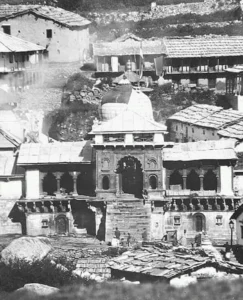
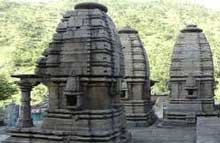
Kyunkaleshwar Temple 8th century Shiva temple established by Sankaracharya during his visit to Pauri with the view of revival of Hinduism. The temple is well renowned in Pauri and nearby areas, people has a very strong belief in the temple with main Deities- Lord Shiva, Parvati, Ganesha, Kartikeya. Other Deities in the temple just behind the main temple are of Lord Rama, Lakshmana & Goddess Sita. One can have a spellbound sight of the magnificent Himalayan ranges along with Alaknanda Valley and town itself from here
Nagdev Much worshipped temple of snake God (Nag) and situated in a dense forest of Pine and Rhododendron. On the way to the temple an observatory is installed from where one can get a gigantic and thrilling view of magnificent Himalayan ranges like Chaukhamba, Gangotri Group, Banderpoonch, Kedardom, Kedarnath etc. The temple is located on Pauri- Bubakhal road and is 5km from bus stop. One can reach there by a trek of 1and 1/2 kms.
Tarakund Situated at a height of 2200 m. Tarakund is a small picturesque spot amidst lofty mountains in the Chariserh Development Area. A small lake and an ancient temple adorn the place. The Teej festival is celebrated with great gaiety when the local people come here to worship and pay homage to God.
How To Reach
By Road Pauri is well connected to Dehradun, Rishikesh, Kotdwar and other cities of the region. Distance of Distt. HQ from State Capital (Dehradun) 181 Km Distance of Distt. HQ from New Delhi 323 Km Distance of Distt. HQ from Nearest Airport (Jolly Grant, Deharadun) 171 Km By Air Nearest airport is Jollygrant (155kms.) via Rishikesh - Srinagar By Train Nearest railway station is Kotdwar (108kms.) Festivals/ Fairs & Mahotsav of Pauri Garhwal
Fairs & Festivals are opportunities to meet each other. In the ancient time, when there were no such facilities of communication and transport, these fairs and festivals have played an important role in social gathering and meeting with relatives, friends resided in the far-away geographical locations.
Together with recreation, these have social significance to remember the religious importance and social messages behind these events. Most of the festivals of the region are based on mythological traditions
Makar Shankranti’, also called ‘Uttarayni’ in Garhwal, is celebrated as ‘Khichriya Shankranti’ in which ‘Khichri’ of ‘Urad Dal’ is prepared and Rice & ‘Urad Dal’ is donated to the Brahmins. On this day, ‘Gindi’ fairs are organized in different places like Dadamandi, Thalnadi etc. of the district.
On ‘Basant Panchami’, also called ‘Sripanchami’, the worships of ‘Kshetrapal’ or ‘Bhumiya’ Devtas are organized and the group folks ‘Thadiya’ and ‘Chauffula’ are started. On ‘Vishuvat Shankranti’, the new year starts and it is celebrated as ‘Vikhoti’. In some places like Trivani near Pokhal, Devalgarh etc., fairs are organized on this day.
Similarly, ‘Holi’, ‘Deepawali’, ‘Shivratri’, ‘Vijayadhasmi’, ‘Rakshabandhan’ are organized with full joys as per Hindu traditions.
Cultural Calendar Of Pauri Garhwal
Name of the Fair Jadaukhand Festival Salta Mahadev Devi Fair Aupakhal Fair Bhaun Fair Subhnath Fair Patoria Fair Nainidanda Bungi Fair Apola Fair Bhaun Fair Goddess(Durga) Fair Lodhli Fair Sobhinath Fair Lord Shiva Fair Kalinka Fair (Biannual) Subhnath Fair Ekeshwar Fair Dewalgarh Fair Mansar Fair Binsar Fair Baikunth Chaturdashi Mundneshwar Fair Satyawan Savitri Fair Juli Sera Dotiyal Diva Fair Devrajkhal Festival Dermad Mahadev Festival Kaulagarh Festival Jethdraj Mori Bilvkedar Shitalamata- Jat Jad-da Devi Kandai Fair Sanglakoti Fair Dangal Fair Khuddu Fair Baisakhi Fair Tateshwar Mahadev Pokharkhal Kanda Fair Thalisain Fair Baisakhi Fair Ghandiyal Festival Syuli Nanda Kathvadhi Fair Dehalchauri Bhagwati Talaiya Ghandyal Devta Nilkantha Duria Festival Kanvashram Fair Be- Mata Ruksh Mahadev Fair Langur Garhi Fair Danda Nagarja Kyunkaleshwar Fair Kandolia Nagdev Vyasghat Fair Shivratri Bagdwal Festival Gindi Fair Tilu Rauteli Ghuleth Festival Nandadevi Fair Nanda Devi Jwalpa Devi Jwer Bunkhal Jhangar
Place Jadaukhand (Nainidanda) Salta Mahadev Adalikhal Saupakhal Bhairangkhal Dhumakot Patoria Danda Nainidanda Haldukhal Apola Khalyundanda Bharolikhal(Bedikhal) Lodhli/Gyuinkhal Sera (Padinda) Bedikhal Kanmali (Beeraunkhal) Jogimadhi(Beeraunkhal) Ekeshwar Dewalgarh Falswari Chauthan, Pithsain Srinagar (Garhwal) Kaljikhal Nyar Valley Kaudiya Lansdowne Chaurikhal Devrajkhal Dermad Badeth Tamleg (Gangwadsyun) Bilvkedar Bhaktiyana Gawani-chopra (Ghat) Kandai Sanglakoti Satpuli Pabo Srinagar(Garhwal) Garh Pokharkhal Kanda Village Pokhari Majhgaon Syunsi/ Beeraunkhal Maximum Villages of Pauri Syuli Khirsu, Guwad, Kothgi Bajida Kanda Beeraunkhal Pang (Pabo Block) Nilkanth (Rishikesh) Bajroan kanvashram Giri Gaon Jagar Gatha Bhairon Garhi Kandyal (Kot Block) Pauri Town Pauri Town Pauri Town -- Kamleshwar (Srinagar) Jaleth Katulsyun Mavakot, Dandamandi Kanda (Rikhnikhal) Chauthan Patti Dhauri Dabralsyun Khola Jwalpa Devi Dewal (Sitonsyun) Bunkhal (Rath) Pauri Village Khola Patti Sitonsuon
Importance/Historical Cultural/Historical Shiv Ratri Goddess Durga Goddess Durga Goddess Bhagwati Dhumadevi Goddess Durga Goddess Durga Goddess Bungi Goddess Bhagwati -- Goddess Durga Goddess Durga Goddess Durga Lord Shiva Goddess Kalinka Lord Subhnath Lord Mahadev Goddess Raj-Rajeshwari Goddess Sita Binsar Kamleshwar Mahadev Lord Mahadev Satyawan Savitri -- Diva Lord Mahadev Lord Mahadev Jethdraj Pandav(after 12 year) Lord Mahadev Shitalamata Vileshwar Mahadev Bhairav Devta Lord Mahadev Lord Mahadev Lord Mahadev Kamleshwar Lord Shiva Nandadevi Manju Ghosh/ Majin Devi Devi Ghandiyal/ Ghantakarna Nanda Game Thaul Devi Ghandiyal Lord Mahadev Duria Kanva Rishi Bhumiyal Lord Mahadev Bhairav Nagarja Lord Mahadev Bhumiyal Lord Hanuman Indraprayag Lord Shiva Bagdwal Ball Festival Tiluveer Bala Veer Devta Nanda -- Jwalpa Lakshman Devi Matta Bhagwati
Time 26th Jan 13-14 Jan 15 April -- July End August Mid First Monday of May Second Monday of May First Monday of May -- -- -- -- -- -- 15 June 30 Dec -- -- -- -- Baikunth Chaturdashi Baikunth Chaturdashi 6th June -- During Summers -- -- -- -- Oct-Feb Shivratri Navratra -- -- -- -- -- Baisakhi -- -- Bhaiyaduj -- -- -- -- -- Bhaiyaduj -- -- Janamasthmi Basant Panchami Basant Panchami -- Navratra -- -- Shivratri Janamasthmi -- -- -- Shivratri During Holi Makar Sankranti -- -- Nandaasthmi Nandaasthmi -- -- -- April