
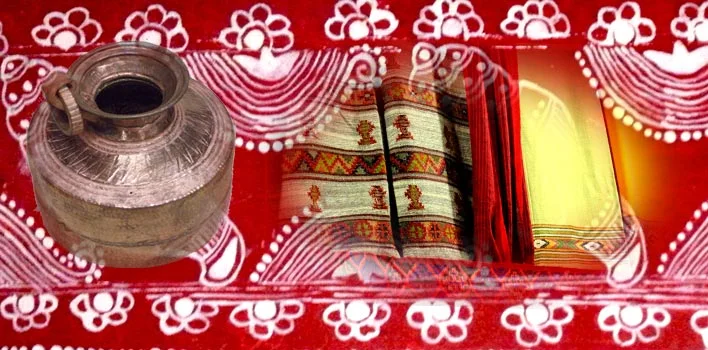
“Handicrafts of Uttarakhand” is not a single style. Craft traditions vary across Kumaon, Garhwal and high-Himalayan communities, connecting ritual, domestic work, dress, architecture and livelihood. A useful introduction should name specific practices rather than reducing everything to generic “Pahadi art.”
Aipan
Aipan is a folk-painting tradition strongly associated with Kumaon. The official Indian handicrafts portal describes a red ochre base, traditionally geru, with white motifs made from rice paste. Designs are created for particular spaces and occasions, including worship, birth and marriage.
Today Aipan motifs also appear on paper, wood, textiles and household objects. That expansion can support artisans, but a printed motif on a mass-produced object is not the same as a hand-made ritual work.
Rangwali Pichhoda
Rangwali Pichhoda is a yellow-to-orange ceremonial textile worn by women in Kumaon during marriages, naming ceremonies, worship and other auspicious occasions. The official handicrafts record describes red or maroon dots and a central symbolic composition. Traditional preparation used natural colour processes, while contemporary production may use blocks and commercial dyes.
Tamta copper work
Kumaon and Garhwal have a long copper-working tradition associated with Tamta craftspeople. Official documentation describes vessels, ritual objects, decorative products, jewellery and musical instruments formed through cutting, hammering, annealing, chiselling, cleaning and polishing.
How to buy responsibly
- Ask whether the object is hand-made, hand-finished or factory printed.
- Look for the artisan, cooperative or self-help group behind the product.
- Pay for skilled labour rather than bargaining only against mass-market prices.
- Do not assume every motif is free of ritual meaning.
- Prefer durable, useful work over souvenir clutter.