UttaraPedia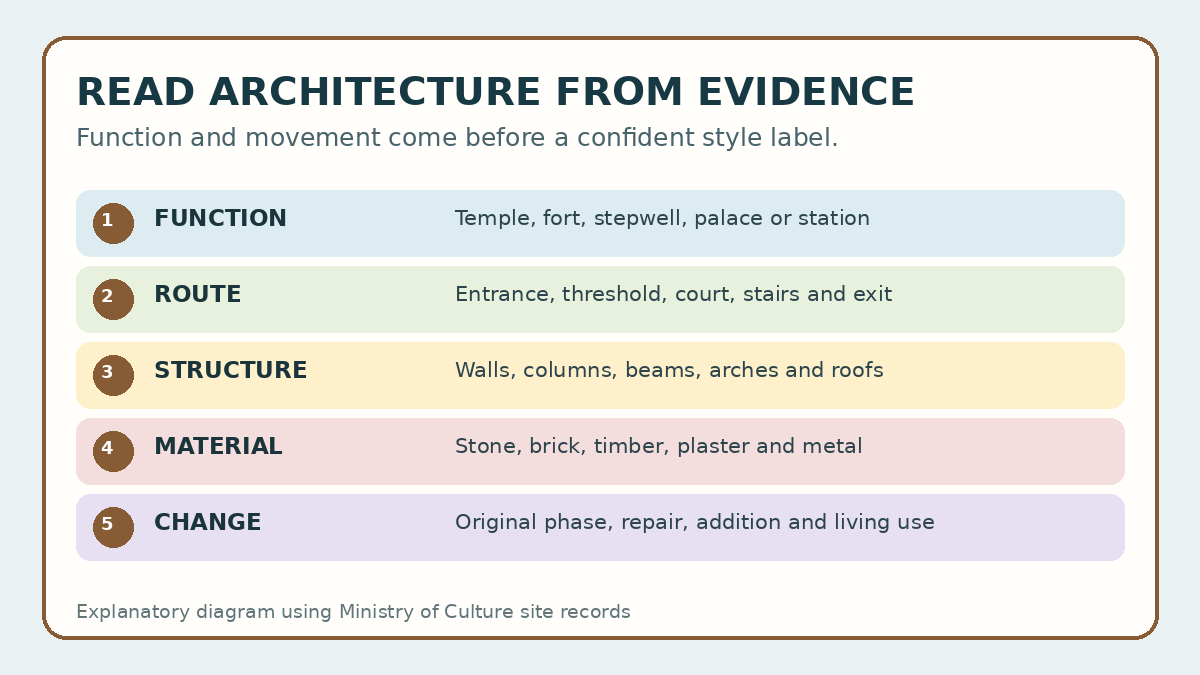
You are standing before an old structure in India. How can you look beyond a quick label such as “ancient temple” or “Mughal building”? Start with evidence you can actually see: the building's purpose, plan, materials, water system, movement route and later additions. Style names are useful only after the basics are clear.
First ask what the place was built to do
A temple, mosque, palace, fort, tomb, stepwell, market, gateway and railway station solve different problems. Function shapes the plan. A fort controls movement and defence; a stepwell creates access to water; a temple organises sacred space and ritual movement. One complex can contain several functions, so label the part you are describing rather than the whole site.
Trace the route through space
Notice the entrance, threshold, courtyard, corridor, stairs, central chamber and exit. Are visitors directed along one axis, around a shrine, down towards water or through successive gates? The route often explains the architecture more clearly than a distant front photograph. Do not enter restricted areas or climb a wall to complete the pattern.
Separate structure from decoration
Columns, beams, arches, vaults, domes and load-bearing walls help a building stand. Carving, inlay, painting, screens and mouldings shape its surface and meaning. A richly carved panel does not tell you how the roof is supported. Look at joins, spans and wall thickness, while remembering that repairs may have changed visible materials.
Read material and climate together
Stone, brick, timber, lime plaster, metal and earth behave differently. Deep shade, courtyards, screens, sloping roofs, drains and raised plinths may respond to heat, rain, snow, dust or water. Avoid claiming that every feature has one cause; ceremonial, practical and aesthetic choices often overlap.
Use official examples to test your eye
The Ministry of Culture describes Rani-ki-Vav as a seven-level stepwell resembling an inverted temple and emphasising the sanctity of water. Its page on the Red Fort notes red sandstone walls, connected pavilions, gardens and a fusion of traditions. The Great Living Chola Temples are identified through towering vimanas, sculpture, engineering and continuing worship.
These examples show why function, movement, material and living use should be read together.
Check date and change
A monument may have been built, expanded, repaired and repurposed in different periods. An information board can distinguish the original phase from a later gateway or restored surface. Read the exact site name and protected boundaries. Do not turn a broad dynasty label into a precise date unless the official interpretation supports it.
A six-note field method
- Write the exact site and structure name.
- Note its main function.
- Sketch the movement route.
- List visible structural systems and materials.
- Record decoration separately.
- Check an official source before naming style or period.
Use our Jageshwar temple-cluster story as a short example, then open the correct record in the Ministry of Culture heritage list. If a destination has several structures, create a separate note for each. Your next useful step is not to memorise ten style labels; it is to make one evidence-based paragraph from the six notes and leave uncertain claims clearly marked for verification.