UttaraPedia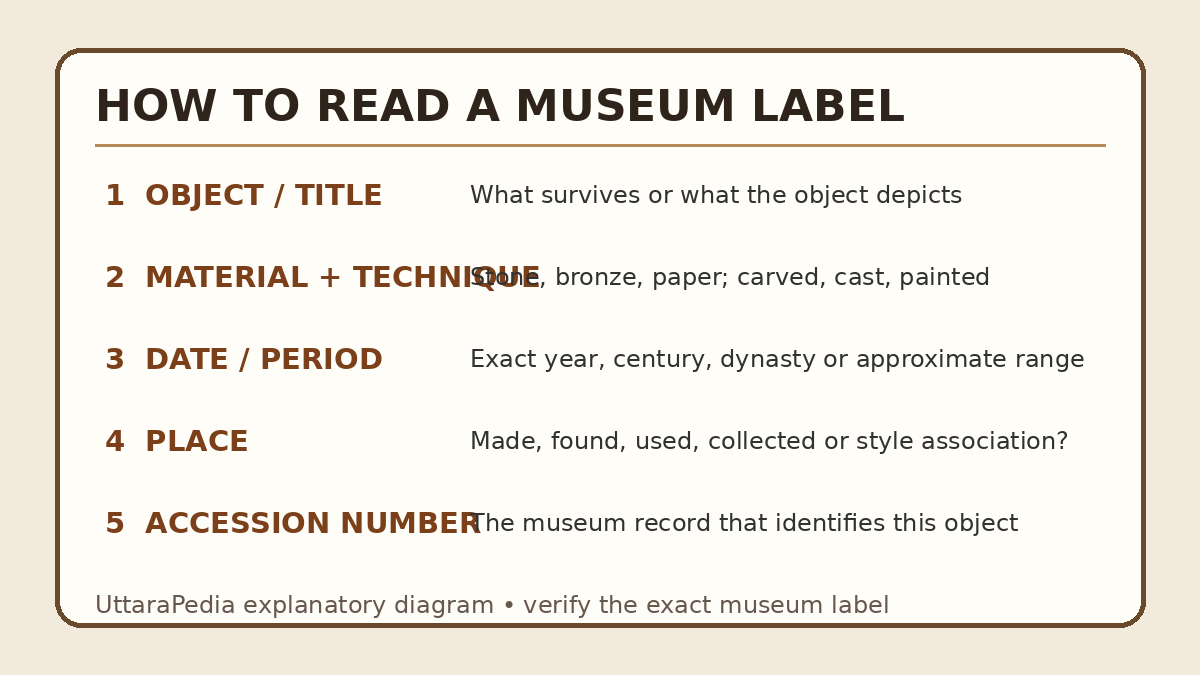
A museum label can look like a short block of text, yet it may answer five different questions: what is the object, what is it made from, when was it made, where is it connected to, and how did it enter the collection? Reading those fields separately turns a quick glance into a useful visit.
Start with the object name, but do not stop there
The first line may give a modern descriptive name, a traditional name or a subject shown in the object. A title is not always the name used by its original maker. If a label says “figure,” “fragment,” “manuscript folio” or “coin,” that word can tell you what survives, not the complete thing that once existed.
Material explains how the object behaves
Stone, bronze, terracotta, paper, cloth, wood and pigment age differently. The material field helps explain weight, surface, colour, damage and conservation needs. Technique is a separate clue: cast, carved, painted, woven or printed describes how material was worked. Do not call every metal object bronze unless the label does.
Period and date need careful language
A label may provide an exact year, a century, a dynasty, a broad period or an estimated range. “12th century” is not the same as “made in 1200,” and “circa” signals an approximate date. When the label uses BCE or CE, preserve that notation in your notes instead of silently converting it.
Place can mean several things
A place name may describe where the object was found, made, used, collected or associated with a style. These are different claims. Read the field heading before writing a caption. A sculpture displayed in Delhi is not automatically from Delhi, and a school of painting can cover a region broader than one modern district.
Accession numbers are useful anchors
The accession or collection number helps distinguish one object from similar works. Record it if you are taking study notes or looking for the object in an online collection. Provenance or acquisition text may state a donor, purchase or excavation context, but absence of that line on a small label does not prove that the museum lacks the record.
Use a two-minute reading order
- Read the title and object type.
- Identify material and technique.
- Separate exact date, approximate date and historical period.
- Check what the place field actually describes.
- Record the accession number and one question for later research.
The National Museum describes collections ranging from archaeology, manuscripts and coins to paintings, textiles and decorative arts, so no single label pattern covers everything. Our museum visit-planning guide covers tickets, closing days and photography rules. At the gallery, take the useful next step: photograph the label only where photography is allowed, or copy its key fields accurately, then use the museum’s official collection page for deeper context.