UttaraPedia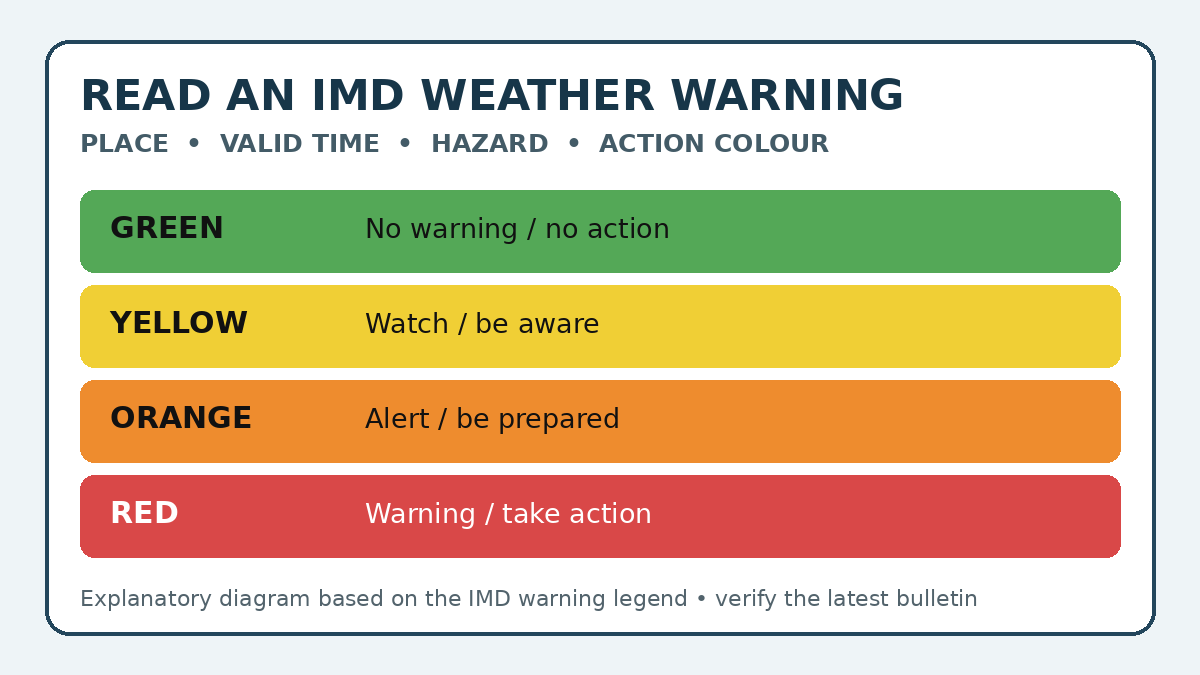
An orange weather panel appears for your district. Does that mean every place will receive the same rain, wind or thunderstorm? No. A useful reading begins with the location, valid period and hazard symbol, and only then moves to the colour. The colour tells you the level of attention or action, not the exact weather at every street.
First match the correct map area
India Meteorological Department publishes subdivision-wise and district-wise warnings. A subdivision can cover several districts, while a district panel is more local. Confirm the state, district or meteorological subdivision named in the bulletin. A warning for one district should not be silently extended to a neighbouring district merely because both appear close on a phone map.
Read the valid period
Every bulletin belongs to an issue time and a valid period. IMD legend pages commonly state that a day’s warning is valid from 08:30 IST on that day to 08:30 IST the next day. Read the exact note printed on the bulletin you are using; do not assume that “Day 1” ends at midnight. Save the issue date as well as the forecast day.
Colour describes the response level
The IMD legend presents green as no warning or no action, yellow as watch or be aware, orange as alert or be prepared to take action, and red as warning or take action. IMD also clarifies that a red colour warning should not automatically be rewritten as the phrase “red alert.” Preserve the wording used in the official legend and read the impact advice attached to the bulletin.
The symbol tells you the hazard
Heavy rain, thunder and lightning, hail, strong surface wind, fog, heat wave, cold wave and heavy snow are different hazards. The same colour can appear with different symbols on different dates or locations. Check the symbol and legend before sharing a screenshot. “Orange today” is incomplete if it does not say orange for what.
Coverage words are not certainty at your pin
Terms such as isolated, scattered, fairly widespread and widespread describe spatial distribution. An isolated event can be severe where it occurs, yet not affect most stations. A broad-area forecast cannot promise the exact start time at one village, road or hotel. Use a local nowcast or district update when available, especially before a mountain drive or outdoor event.
A six-point reading routine
- Match the state, subdivision and district.
- Note issue date and time.
- Read the valid period.
- Identify the hazard symbol.
- Read the colour and action wording.
- Check a newer bulletin before departure.
Our place-and-validity story gives the same check in a quick format. For the live source, use the IMD warning page. The practical next step is to write one complete line before forwarding a warning: place, valid period, hazard and colour. That line is more useful than a cropped map without its legend.